Bleaching Powder, 45g
$5.99
Permanent color adds dye molecules to the hair fiber. Putting our Light Brown or Chestnut Brown over dark hair only deposits more pigment, making the strand look darker or unchanged. Lightening requires lifting the existing pigment first.
Our shampoo-style bottles dispense an oxidative dye containing p-phenylenediamine, resorcinol, m-aminophenol, ethanolamine, and hydrogen peroxide as one liquid from a pump. When this liquid coats a dark fiber, it forms new color molecules inside the strand. Those added pigments sit alongside the dark pigment already present. The result is a deeper shade rather than a lighter one, because permanent dye builds density rather than wiping away base pigment.
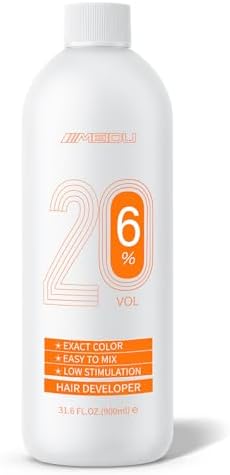
Removing existing natural or artificial pigment demands dedicated lighteners before any target shade is applied. Our mixing bench contains bleaching powder in 45 g and 100 g options, along with a creme lightener in 150 g. These lighteners combine with our developer at 20 vol (6%) or developer at 30 vol (9%), or come ready in a boxed bleach kit. This chemical process breaks apart the dark melanin so the strand can accept a lighter tone.
Hair that has just undergone bleaching does not look like a finished target shade. Stripping dark pigment leaves the fiber showing pale yellow, brassy gold, or raw orange tones. Our purple toner in 500 ml exists to neutralize unwanted brassiness on pale strands before or alongside further coloring. Without balancing these raw undertones, applying a lighter brown or burgundy dye will produce muddy or unpredictable results.
Leaving color on dark hair past the printed 20-25 minutes processing time will not force the shade lighter. Extended contact merely exposes the scalp to prolonged alkaline action and oxidative stress without removing underlying pigment. Every application requires a patch test 48 hours before use, and our wash-in care line, including the conditioning mask, helps condition the fiber after the chemistry completes its work.
Anyone with uneven artificial black dye, heavily compromised strands, or a history of allergic reactions should consult a licensed colorist rather than attempting multi-step bleaching at home. Significant color shifts demand precise sectioning, strand monitoring, and tailored developer choices that go beyond a single home session. If a scalp shows irritation, redness, or broken skin, stop all application and consult a doctor.
We formulate our 9 shades to deposit permanent oxidative pigment, but we do not promise specific lightness, uniform coverage on resistant fiber, or identical outcomes on every head. Final color depends entirely on the starting base, previous chemical history, and strand porosity.