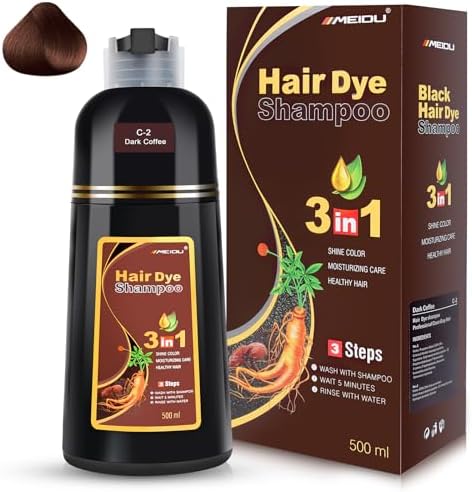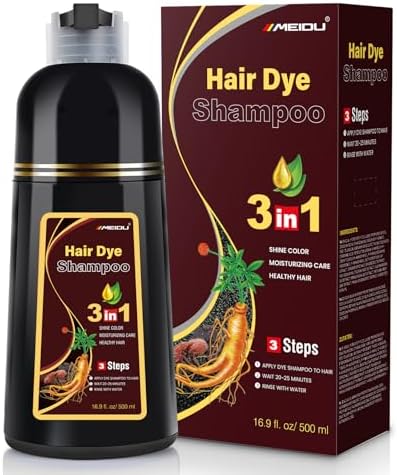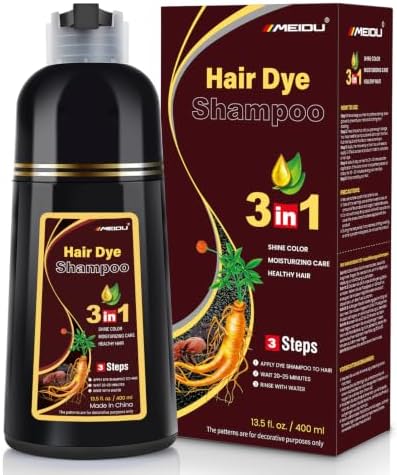
Burgundy Hair Dye Shampoo
$22.49
We blend permanent oxidative dye into a single liquid pump bottle. The 20-25 minutes on your head are required for an exact chemical sequence: lifting the cuticle, oxidizing natural melanin, and coupling small aromatic intermediates into trapped color molecules within the fiber cortex.
When you press the pump, the formulation exits as one liquid containing p-phenylenediamine, resorcinol, m-aminophenol, ethanolamine, and hydrogen peroxide. Contact with air and the moisture on the hair strand starts the chemical reaction immediately. You apply it straight to dry strands without a mixing bowl, but the formulation acts as a full chemical processing system from the first minute.
Ethanolamine swells the outer hair shaft to lift the overlapping cuticle scales. Hydrogen peroxide then moves past the surface into the cortex, where it lightens natural melanin fragments. This chemical lightening creates room within the cortex structure and clears a base for the incoming synthetic shade to develop properly during the full processing window.
Tiny uncolored precursor molecules, including p-phenylenediamine and m-aminophenol, migrate through the open cuticle into the inner cortex. Hydrogen peroxide oxidizes these small precursors so they bind to couplers like resorcinol. These paired components link into large, complex dye molecules that become physically too big to slip back through the cuticle layer.
Permanent color is defined by this interior trapping mechanism, not by surface coating. The 20-25 minutes printed on our labels give the oxidative reaction adequate time to complete its molecular coupling inside the cortex. A shampoo-style bottle format alters how you handle the product at the sink, yet the core oxidative chemistry remains identical to traditional salon formulations.
Alkaline swelling and oxidation inevitably leave the cuticle rougher than it was before application. The hair fiber loses surface smoothness once the outer scales are forced open by ethanolamine and peroxide. Conditioning with our keratin mask helps lubricate the roughened surface, but the underlying cuticle layer will remain structurally altered by the chemical process.
Because every head of hair has a unique starting porosity and history, we cannot promise uniform dye absorption, zero strand dryness, or specific shade depth. Always perform a patch test 48 hours before coloring, and consult a doctor regarding any chemical sensitivities.